> ## Documentation Index
> Fetch the complete documentation index at: https://docs.langchain.com/llms.txt
> Use this file to discover all available pages before exploring further.
# Set up Agent Auth (Beta)
> Enable secure access from agents to any system using OAuth 2.0 credentials with Agent Auth.
Agent Auth is in **Beta** and under active development. To provide feedback or use this feature, reach out to the [LangChain team](https://forum.langchain.com/c/help/langsmith/).
## Installation
```bash pip theme={"theme":{"light":"catppuccin-latte","dark":"catppuccin-mocha"}}
pip install langchain-auth
```
```bash uv theme={"theme":{"light":"catppuccin-latte","dark":"catppuccin-mocha"}}
uv add langchain-auth
```
```bash theme={"theme":{"light":"catppuccin-latte","dark":"catppuccin-mocha"}}
npm install @langchain/auth
```
## Quickstart
### 1. Initialize the client
```python theme={"theme":{"light":"catppuccin-latte","dark":"catppuccin-mocha"}}
from langchain_auth import Client
client = Client(api_key="your-langsmith-api-key")
```
```javascript theme={"theme":{"light":"catppuccin-latte","dark":"catppuccin-mocha"}}
import { Client } from '@langchain/auth';
const client = new Client({ apiKey: 'your-langsmith-api-key' });
```
#### Self-hosted configuration
For self-hosted LangSmith instances, specify the API URL using the `/api-host` path on your instance.
```bash theme={"theme":{"light":"catppuccin-latte","dark":"catppuccin-mocha"}}
export LANGSMITH_API_URL="https://your-langsmith-instance.com/api-host"
```
Then initialize the client normally:
```python theme={"theme":{"light":"catppuccin-latte","dark":"catppuccin-mocha"}}
client = Client(api_key="your-langsmith-api-key")
```
```python theme={"theme":{"light":"catppuccin-latte","dark":"catppuccin-mocha"}}
client = Client(
api_key="your-langsmith-api-key",
api_url="https://your-langsmith-instance.com/api-host"
)
```
```javascript theme={"theme":{"light":"catppuccin-latte","dark":"catppuccin-mocha"}}
const client = new Client({
apiKey: 'your-langsmith-api-key',
apiUrl: 'https://your-langsmith-instance.com/api-host'
});
```
### 2. Set up OAuth providers
Before agents can authenticate, you need to configure an OAuth provider using the following process:
1. Select a unique identifier for your OAuth provider to use in LangChain's platform (e.g., "github-local-dev", "google-workspace-prod").
2. Go to your OAuth provider's developer console and create a new OAuth application.
3. Set the callback URL in your OAuth provider:
```
https://smith.langchain.com/host-oauth-callback/{provider_id}
```
For example, if your provider\_id is "github-local-dev", use:
```
https://smith.langchain.com/host-oauth-callback/github-local-dev
```
```
https://{your-langsmith-instance}/host-oauth-callback/{provider_id}
```
For example, if your instance is `langsmith.example.com` and provider\_id is "github", use:
```
https://langsmith.example.com/host-oauth-callback/github
```
4. Use `client.create_oauth_provider()` with the credentials from your OAuth app:
```python theme={"theme":{"light":"catppuccin-latte","dark":"catppuccin-mocha"}}
new_provider = await client.create_oauth_provider(
provider_id="{provider_id}", # Provide any unique ID
name="{provider_display_name}", # Provide any display name
client_id="{your_client_id}",
client_secret="{your_client_secret}",
auth_url="{auth_url_of_your_provider}",
token_url="{token_url_of_your_provider}",
)
```
```javascript theme={"theme":{"light":"catppuccin-latte","dark":"catppuccin-mocha"}}
const newProvider = await client.createOAuthProvider({
providerId: '{provider_id}', // Provide any unique ID
name: '{provider_display_name}', // Provide any display name
clientId: '{your_client_id}',
clientSecret: '{your_client_secret}',
authUrl: '{auth_url_of_your_provider}',
tokenUrl: '{token_url_of_your_provider}',
});
```
### 3. Authenticate from an agent
The client `authenticate()` API is used to get OAuth tokens from pre-configured providers. On the first call, it takes the caller through an OAuth 2.0 auth flow.
#### In LangGraph context
By default, tokens are scoped to the calling agent using the Assistant ID parameter.
```python theme={"theme":{"light":"catppuccin-latte","dark":"catppuccin-mocha"}}
auth_result = await client.authenticate(
provider="{provider_id}",
scopes=["scopeA"],
user_id="your_user_id" # Any unique identifier to scope this token to the human caller
)
# Or explicitly specify an agent_id for agent-scoped tokens
auth_result = await client.authenticate(
provider="{provider_id}",
scopes=["scopeA"],
user_id="your_user_id",
agent_id="specific-agent-id" # Optional: explicitly set agent scope
)
```
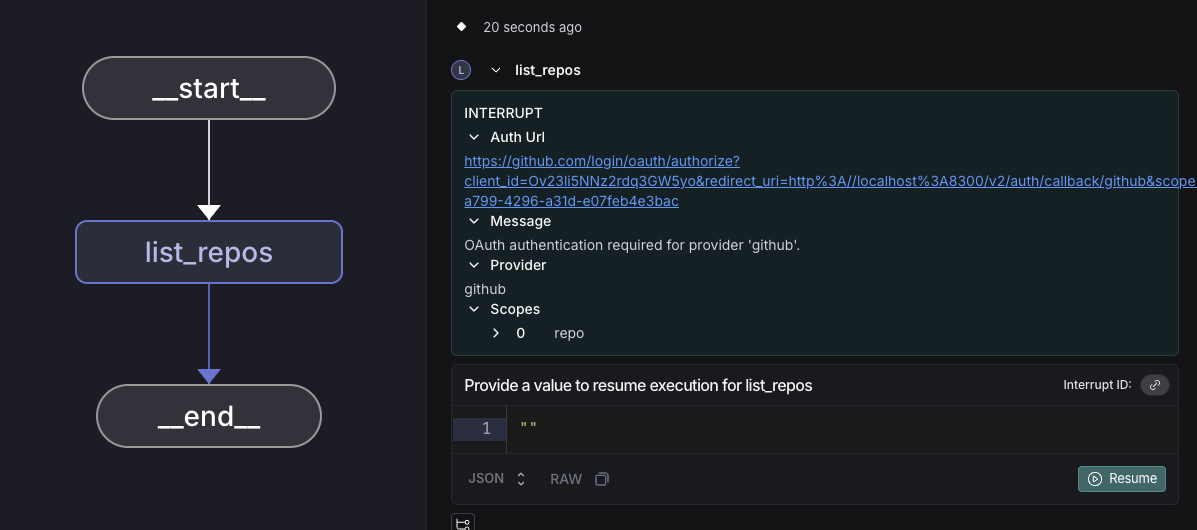
During execution, if authentication is required, the SDK will throw an [interrupt](https://langchain-ai.github.io/langgraph/how-tos/human_in_the_loop/add-human-in-the-loop/#pause-using-interrupt). The agent execution pauses and presents the OAuth URL to the user:
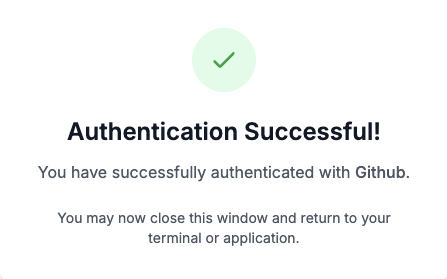
 After the user completes OAuth authentication and we receive the callback from the provider, they will see the auth success page.
 The agent then resumes execution from the point it left off at, and the token can be used for any API calls. We store and refresh OAuth tokens so that future uses of the service by either the user or agent do not require an OAuth flow.
```python theme={"theme":{"light":"catppuccin-latte","dark":"catppuccin-mocha"}}
token = auth_result.token
```
#### Outside LangGraph context
Provide the `auth_url` to the user for out-of-band OAuth flows.
```python theme={"theme":{"light":"catppuccin-latte","dark":"catppuccin-mocha"}}
auth_result = await client.authenticate(
provider="{provider_id}",
scopes=["scopeA"],
user_id="your_user_id"
)
if auth_result.status == "pending":
print(f"Complete OAuth at: {auth_result.url}")
# Wait for user to complete OAuth
completed_auth = await client.wait_for_completion(auth_result.auth_id)
print("Authentication completed!")
else:
token = auth_result.token
print(f"Already authenticated, token: {token}")
```
```javascript theme={"theme":{"light":"catppuccin-latte","dark":"catppuccin-mocha"}}
const authResult = await client.authenticate({
provider: '{provider_id}',
scopes: ['scopeA'],
userId: 'your_user_id'
});
if (authResult.status === 'pending') {
console.log(`Complete OAuth at: ${authResult.authUrl}`);
// Wait for user to complete OAuth
const completedAuth = await client.waitForCompletion(authResult.authId);
console.log('Authentication completed!');
} else {
const token = authResult.token;
console.log(`Already authenticated, token: ${token}`);
}
```
## Troubleshooting
### Self-hosted: 405 Method Not Allowed
If you receive a `405 Method Not Allowed` error, ensure `LANGSMITH_API_URL` points to the `/api-host` path:
```bash theme={"theme":{"light":"catppuccin-latte","dark":"catppuccin-mocha"}}
export LANGSMITH_API_URL="https://your-instance.com/api-host"
```
### Self-hosted: Malformed OAuth callback URL
Ensure your OAuth provider's redirect URI matches your LangSmith instance URL:
```
https://your-instance.com/host-oauth-callback/{provider_id}
```
***
The agent then resumes execution from the point it left off at, and the token can be used for any API calls. We store and refresh OAuth tokens so that future uses of the service by either the user or agent do not require an OAuth flow.
```python theme={"theme":{"light":"catppuccin-latte","dark":"catppuccin-mocha"}}
token = auth_result.token
```
#### Outside LangGraph context
Provide the `auth_url` to the user for out-of-band OAuth flows.
```python theme={"theme":{"light":"catppuccin-latte","dark":"catppuccin-mocha"}}
auth_result = await client.authenticate(
provider="{provider_id}",
scopes=["scopeA"],
user_id="your_user_id"
)
if auth_result.status == "pending":
print(f"Complete OAuth at: {auth_result.url}")
# Wait for user to complete OAuth
completed_auth = await client.wait_for_completion(auth_result.auth_id)
print("Authentication completed!")
else:
token = auth_result.token
print(f"Already authenticated, token: {token}")
```
```javascript theme={"theme":{"light":"catppuccin-latte","dark":"catppuccin-mocha"}}
const authResult = await client.authenticate({
provider: '{provider_id}',
scopes: ['scopeA'],
userId: 'your_user_id'
});
if (authResult.status === 'pending') {
console.log(`Complete OAuth at: ${authResult.authUrl}`);
// Wait for user to complete OAuth
const completedAuth = await client.waitForCompletion(authResult.authId);
console.log('Authentication completed!');
} else {
const token = authResult.token;
console.log(`Already authenticated, token: ${token}`);
}
```
## Troubleshooting
### Self-hosted: 405 Method Not Allowed
If you receive a `405 Method Not Allowed` error, ensure `LANGSMITH_API_URL` points to the `/api-host` path:
```bash theme={"theme":{"light":"catppuccin-latte","dark":"catppuccin-mocha"}}
export LANGSMITH_API_URL="https://your-instance.com/api-host"
```
### Self-hosted: Malformed OAuth callback URL
Ensure your OAuth provider's redirect URI matches your LangSmith instance URL:
```
https://your-instance.com/host-oauth-callback/{provider_id}
```
***
[Connect these docs](/use-these-docs) to Claude, VSCode, and more via MCP for real-time answers.
[Edit this page on GitHub](https://github.com/langchain-ai/docs/edit/main/src/langsmith/agent-auth.mdx) or [file an issue](https://github.com/langchain-ai/docs/issues/new/choose).