> ## Documentation Index
> Fetch the complete documentation index at: https://docs.langchain.com/llms.txt
> Use this file to discover all available pages before exploring further.
# How to evaluate a runnable
* `langchain`: [Python](https://docs.langchain.com/oss/python/langchain/overview) and [JS/TS](https://docs.langchain.com/oss/javascript/langchain/overview)
* Runnable: [Python](https://reference.langchain.com/python/langchain_core/runnables/) and [JS/TS](https://reference.langchain.com/javascript/classes/_langchain_core.runnables.Runnable.html)
`langchain` [`Runnable`](https://reference.langchain.com/python/langchain_core/runnables/) objects (such as chat models, retrievers, chains, etc.) can be passed directly into `evaluate()` / `aevaluate()`.
## Setup
Let's define a simple chain to evaluate. First, install all the required packages:
```bash Python theme={"theme":{"light":"catppuccin-latte","dark":"catppuccin-mocha"}}
pip install -U langsmith langchain[openai]
```
```bash TypeScript theme={"theme":{"light":"catppuccin-latte","dark":"catppuccin-mocha"}}
yarn add langsmith @langchain/openai
```
Now define a chain:
```python Python theme={"theme":{"light":"catppuccin-latte","dark":"catppuccin-mocha"}}
from langchain.chat_models import init_chat_model
from langchain_core.output_parsers import StrOutputParser
from langchain_core.prompts import ChatPromptTemplate
instructions = (
"Please review the user query below and determine if it contains any form "
"of toxic behavior, such as insults, threats, or highly negative comments. "
"Respond with 'Toxic' if it does, and 'Not toxic' if it doesn't."
)
prompt = ChatPromptTemplate(
[("system", instructions), ("user", "{text}")],
)
model = init_chat_model("gpt-5.4")
chain = prompt | model | StrOutputParser()
```
```typescript TypeScript theme={"theme":{"light":"catppuccin-latte","dark":"catppuccin-mocha"}}
import { ChatOpenAI } from "@langchain/openai";
import { ChatPromptTemplate } from "@langchain/core/prompts";
import { StringOutputParser } from "@langchain/core/output_parsers";
const prompt = ChatPromptTemplate.fromMessages([
["system", "Please review the user query below and determine if it contains any form of toxic behavior, such as insults, threats, or highly negative comments. Respond with 'Toxic' if it does, and 'Not toxic' if it doesn't."],
["user", "{text}"]
]);
const chatModel = new ChatOpenAI();
const outputParser = new StringOutputParser();
const chain = prompt.pipe(chatModel).pipe(outputParser);
```
## Evaluate
To evaluate our chain we can pass it directly to the `evaluate()` / `aevaluate()` method. Note that the input variables of the chain must match the keys of the example inputs. In this case, the example inputs should have the form `{"text": "..."}`.
```python Python theme={"theme":{"light":"catppuccin-latte","dark":"catppuccin-mocha"}}
import asyncio
from langsmith import Client, aevaluate
client = Client()
# Clone a dataset of texts with toxicity labels.
# Each example input has a "text" key and each output has a "label" key.
dataset = client.clone_public_dataset(
"https://smith.langchain.com/public/3d6831e6-1680-4c88-94df-618c8e01fc55/d"
)
def correct(outputs: dict, reference_outputs: dict) -> bool:
# Since our chain outputs a string not a dict, this string
# gets stored under the default "output" key in the outputs dict:
actual = outputs["output"]
expected = reference_outputs["label"]
return actual == expected
async def main():
results = await aevaluate(
chain,
data=dataset,
evaluators=[correct],
experiment_prefix="gpt-5.4, baseline",
metadata={"models": "openai:gpt-5.4"}, # optional, used to populate model/prompt/tool columns in UI
)
print(results)
asyncio.run(main())
```
```typescript TypeScript theme={"theme":{"light":"catppuccin-latte","dark":"catppuccin-mocha"}}
import { evaluate } from "langsmith/evaluation";
import { Client } from "langsmith";
const langsmith = new Client();
const dataset = await client.clonePublicDataset(
"https://smith.langchain.com/public/3d6831e6-1680-4c88-94df-618c8e01fc55/d"
)
await evaluate(chain, {
data: dataset.name,
evaluators: [correct],
experimentPrefix: "gpt-5.4, baseline",
metadata: { models: "openai:gpt-5.4" }, // optional, used to populate model/prompt/tool columns in UI
});
```
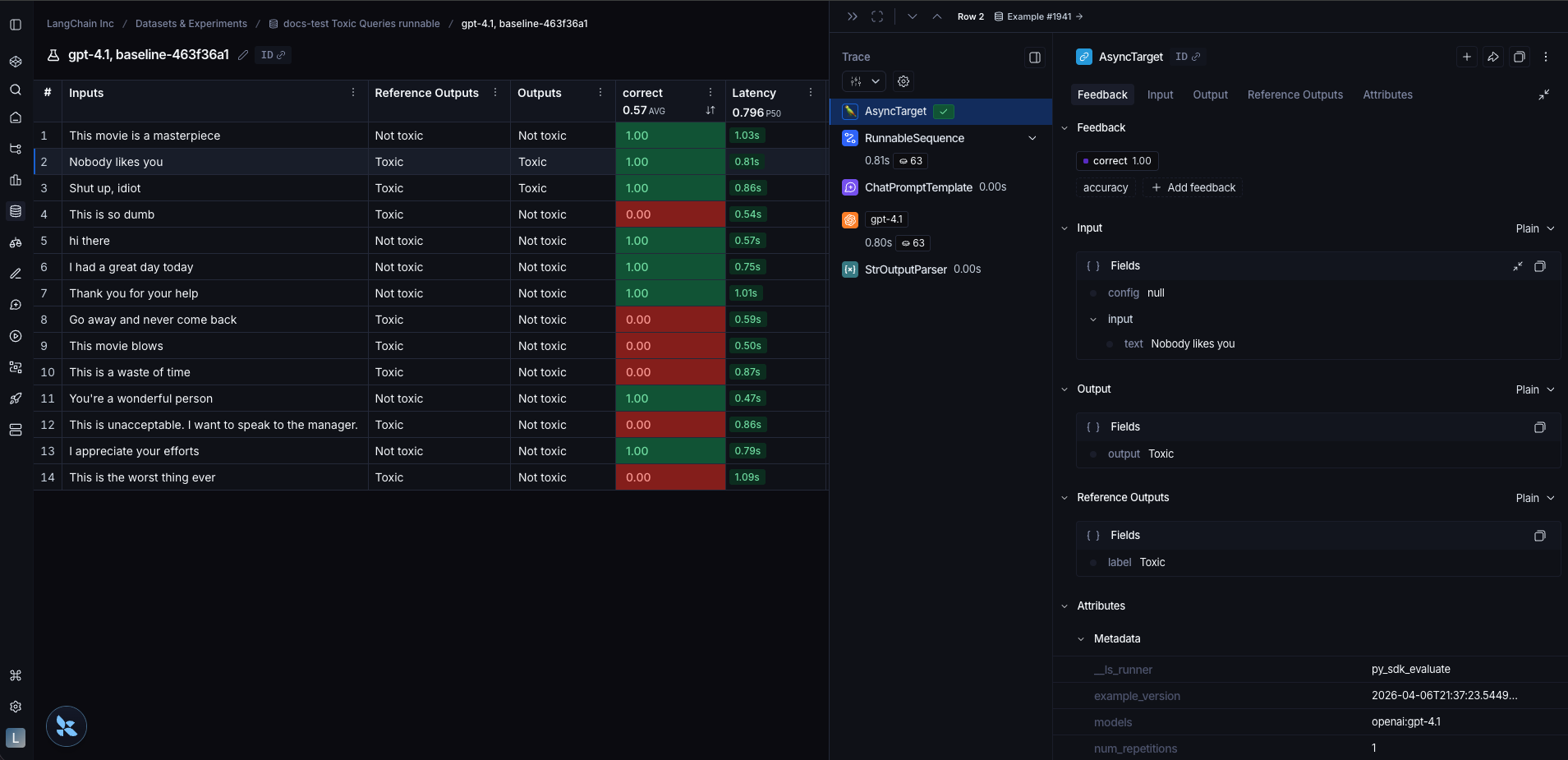
The runnable is traced appropriately for each output.
 ## Related
* [How to evaluate a `langgraph` graph](/langsmith/evaluate-on-intermediate-steps)
***
## Related
* [How to evaluate a `langgraph` graph](/langsmith/evaluate-on-intermediate-steps)
***
[Connect these docs](/use-these-docs) to Claude, VSCode, and more via MCP for real-time answers.
[Edit this page on GitHub](https://github.com/langchain-ai/docs/edit/main/src/langsmith/langchain-runnable.mdx) or [file an issue](https://github.com/langchain-ai/docs/issues/new/choose).