> ## Documentation Index
> Fetch the complete documentation index at: https://docs.langchain.com/llms.txt
> Use this file to discover all available pages before exploring further.
# How to return multiple scores in one evaluator
Sometimes it is useful for a custom evaluator or summary evaluator to return multiple metrics. For example, if you have multiple metrics being generated by an LLM judge, you can save time and money by making a single LLM call that generates multiple metrics instead of making multiple LLM calls.
To return multiple scores using the Python SDK, simply return a list of dictionaries/objects of the following form:
```python theme={"theme":{"light":"catppuccin-latte","dark":"catppuccin-mocha"}}
[
# 'key' is the metric name
# 'score' is the value of a numerical metric
{"key": string, "score": number},
# 'value' is the value of a categorical metric
{"key": string, "value": string},
... # You may log as many as you wish
]
```
To do so with the JS/TS SDK, return an object with a 'results' key and then a list of the above form
```typescript theme={"theme":{"light":"catppuccin-latte","dark":"catppuccin-mocha"}}
{results: [{ key: string, score: number }, ...]};
```
Each of these dictionaries can contain any or all of the [feedback fields](/langsmith/feedback-data-format); check out the linked document for more information.
Example:
* Python: Requires `langsmith>=0.2.0`
* TypeScript: Support for multiple scores is available in `langsmith@0.1.32` and higher
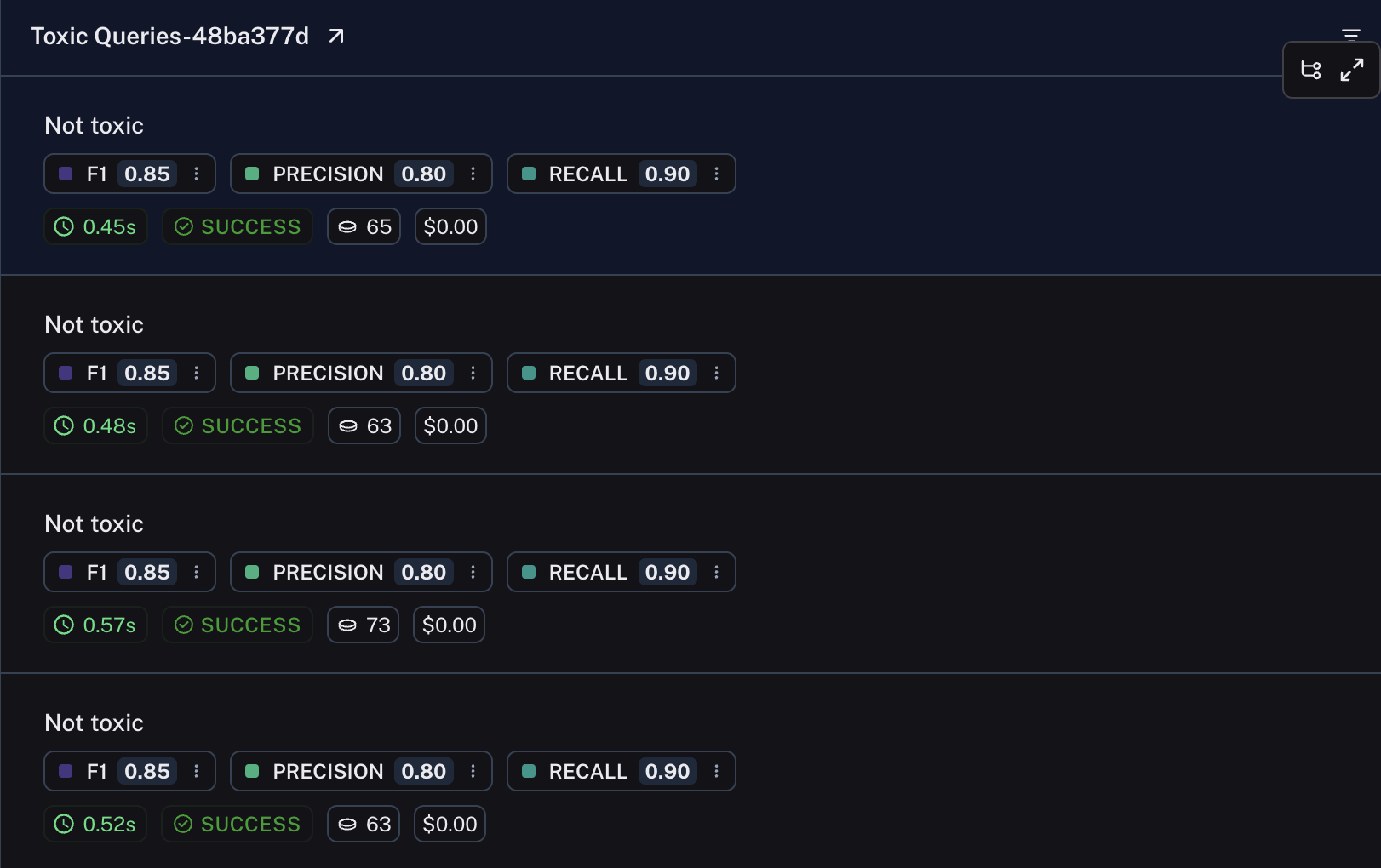
```python Python theme={"theme":{"light":"catppuccin-latte","dark":"catppuccin-mocha"}}
def multiple_scores(outputs: dict, reference_outputs: dict) -> list[dict]:
# Replace with real evaluation logic.
precision = 0.8
recall = 0.9
f1 = 0.85
return [
{"key": "precision", "score": precision},
{"key": "recall", "score": recall},
{"key": "f1", "score": f1},
]
```
```typescript TypeScript theme={"theme":{"light":"catppuccin-latte","dark":"catppuccin-mocha"}}
import type { Run, Example } from "langsmith/schemas";
function multipleScores(rootRun: Run, example: Example) {
// Your evaluation logic here
return {
results: [
{ key: "precision", score: 0.8 },
{ key: "recall", score: 0.9 },
{ key: "f1", score: 0.85 },
],
};
}
```
Rows from the resulting experiment will display each of the scores.
 ## Related
* [Return categorical vs numerical metrics](/langsmith/metric-type)
***
## Related
* [Return categorical vs numerical metrics](/langsmith/metric-type)
***
[Connect these docs](/use-these-docs) to Claude, VSCode, and more via MCP for real-time answers.
[Edit this page on GitHub](https://github.com/langchain-ai/docs/edit/main/src/langsmith/multiple-scores.mdx) or [file an issue](https://github.com/langchain-ai/docs/issues/new/choose).