> ## Documentation Index
> Fetch the complete documentation index at: https://docs.langchain.com/llms.txt
> Use this file to discover all available pages before exploring further.
# Use time-travel
> Replay past executions and fork to explore alternative paths in LangGraph
## Overview
LangGraph supports time travel through [checkpoints](/oss/python/langgraph/persistence#checkpoints):
* **[Replay](#replay)**: Retry from a prior checkpoint.
* **[Fork](#fork)**: Branch from a prior checkpoint with modified state to explore an alternative path.
Both work by resuming from a prior checkpoint. Nodes before the checkpoint are not re-executed (results are already saved). Nodes after the checkpoint re-execute, including any LLM calls, API requests, and [interrupts](/oss/python/langgraph/interrupts) (which may produce different results).
## Replay
Invoke the graph with a prior checkpoint's config to replay from that point.
Replay re-executes nodes—it doesn't just read from cache. LLM calls, API requests, and [interrupts](/oss/python/langgraph/interrupts) fire again and may return different results. Replaying from the final checkpoint (no `next` nodes) is a no-op.
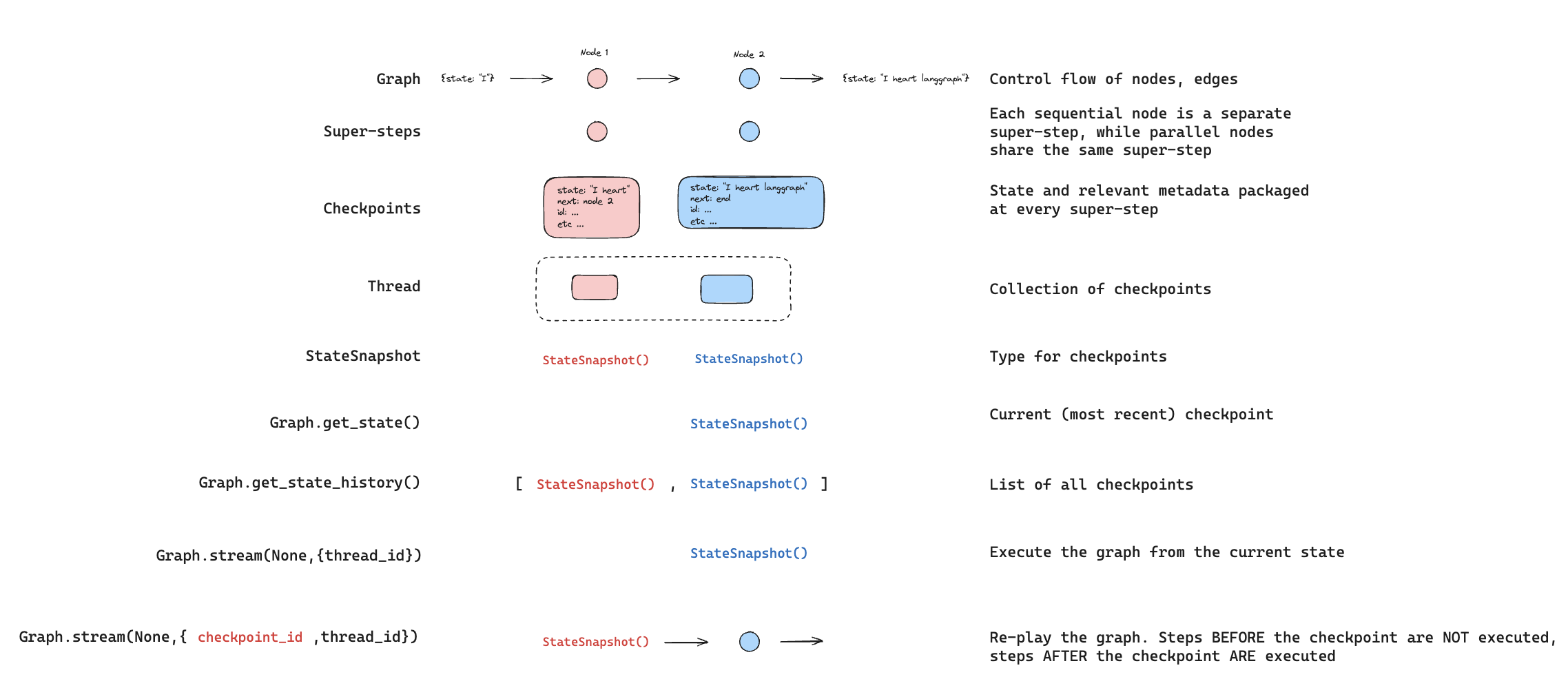 Use [`get_state_history`](https://reference.langchain.com/python/langgraph/graphs/#langgraph.graph.state.CompiledStateGraph.get_state_history) to find the checkpoint you want to replay from, then call [`invoke`](https://reference.langchain.com/python/langgraph/graphs/#langgraph.graph.state.CompiledStateGraph.invoke) with that checkpoint's config:
```python theme={"theme":{"light":"catppuccin-latte","dark":"catppuccin-mocha"}}
from langgraph.graph import StateGraph, START
from langgraph.checkpoint.memory import InMemorySaver
from typing_extensions import TypedDict, NotRequired
from langchain_core.utils.uuid import uuid7
class State(TypedDict):
topic: NotRequired[str]
joke: NotRequired[str]
def generate_topic(state: State):
return {"topic": "socks in the dryer"}
def write_joke(state: State):
return {"joke": f"Why do {state['topic']} disappear? They elope!"}
checkpointer = InMemorySaver()
graph = (
StateGraph(State)
.add_node("generate_topic", generate_topic)
.add_node("write_joke", write_joke)
.add_edge(START, "generate_topic")
.add_edge("generate_topic", "write_joke")
.compile(checkpointer=checkpointer)
)
# Step 1: Run the graph
config = {"configurable": {"thread_id": str(uuid7())}}
result = graph.invoke({}, config)
# Step 2: Find a checkpoint to replay from
history = list(graph.get_state_history(config))
# History is in reverse chronological order
for state in history:
print(f"next={state.next}, checkpoint_id={state.config['configurable']['checkpoint_id']}")
# Step 3: Replay from a specific checkpoint
# Find the checkpoint before write_joke
before_joke = next(s for s in history if s.next == ("write_joke",))
replay_result = graph.invoke(None, before_joke.config)
# write_joke re-executes (runs again), generate_topic does not
```
## Fork
Fork creates a new branch from a past checkpoint with modified state. Call [`update_state`](https://reference.langchain.com/python/langgraph/graphs/#langgraph.graph.state.CompiledStateGraph.update_state) on a prior checkpoint to create the fork, then [`invoke`](https://reference.langchain.com/python/langgraph/graphs/#langgraph.graph.state.CompiledStateGraph.invoke) with `None` to continue execution.
Use [`get_state_history`](https://reference.langchain.com/python/langgraph/graphs/#langgraph.graph.state.CompiledStateGraph.get_state_history) to find the checkpoint you want to replay from, then call [`invoke`](https://reference.langchain.com/python/langgraph/graphs/#langgraph.graph.state.CompiledStateGraph.invoke) with that checkpoint's config:
```python theme={"theme":{"light":"catppuccin-latte","dark":"catppuccin-mocha"}}
from langgraph.graph import StateGraph, START
from langgraph.checkpoint.memory import InMemorySaver
from typing_extensions import TypedDict, NotRequired
from langchain_core.utils.uuid import uuid7
class State(TypedDict):
topic: NotRequired[str]
joke: NotRequired[str]
def generate_topic(state: State):
return {"topic": "socks in the dryer"}
def write_joke(state: State):
return {"joke": f"Why do {state['topic']} disappear? They elope!"}
checkpointer = InMemorySaver()
graph = (
StateGraph(State)
.add_node("generate_topic", generate_topic)
.add_node("write_joke", write_joke)
.add_edge(START, "generate_topic")
.add_edge("generate_topic", "write_joke")
.compile(checkpointer=checkpointer)
)
# Step 1: Run the graph
config = {"configurable": {"thread_id": str(uuid7())}}
result = graph.invoke({}, config)
# Step 2: Find a checkpoint to replay from
history = list(graph.get_state_history(config))
# History is in reverse chronological order
for state in history:
print(f"next={state.next}, checkpoint_id={state.config['configurable']['checkpoint_id']}")
# Step 3: Replay from a specific checkpoint
# Find the checkpoint before write_joke
before_joke = next(s for s in history if s.next == ("write_joke",))
replay_result = graph.invoke(None, before_joke.config)
# write_joke re-executes (runs again), generate_topic does not
```
## Fork
Fork creates a new branch from a past checkpoint with modified state. Call [`update_state`](https://reference.langchain.com/python/langgraph/graphs/#langgraph.graph.state.CompiledStateGraph.update_state) on a prior checkpoint to create the fork, then [`invoke`](https://reference.langchain.com/python/langgraph/graphs/#langgraph.graph.state.CompiledStateGraph.invoke) with `None` to continue execution.
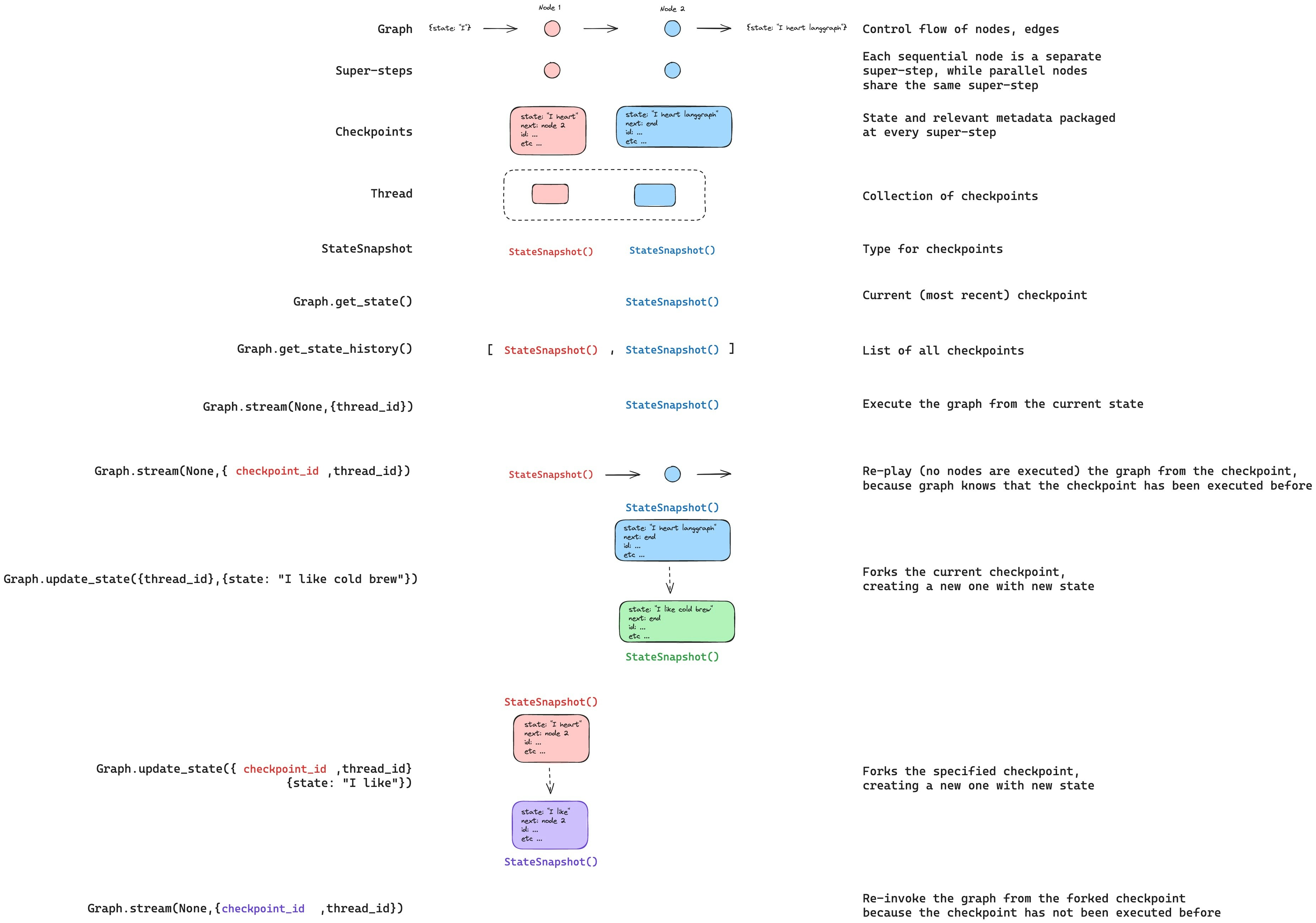 `update_state` does **not** roll back a thread. It creates a new checkpoint that branches from the specified point. The original execution history remains intact.
```python theme={"theme":{"light":"catppuccin-latte","dark":"catppuccin-mocha"}}
# Find checkpoint before write_joke
history = list(graph.get_state_history(config))
before_joke = next(s for s in history if s.next == ("write_joke",))
# Fork: update state to change the topic
fork_config = graph.update_state(
before_joke.config,
values={"topic": "chickens"},
)
# Resume from the fork — write_joke re-executes with the new topic
fork_result = graph.invoke(None, fork_config)
print(fork_result["joke"]) # A joke about chickens, not socks
```
### From a specific node
When you call [`update_state`](https://reference.langchain.com/python/langgraph/graphs/#langgraph.graph.state.CompiledStateGraph.update_state), values are applied using the specified node's writers (including [reducers](/oss/python/langgraph/graph-api#reducers)). The checkpoint records that node as having produced the update, and execution resumes from that node's successors.
By default, LangGraph infers `as_node` from the checkpoint's version history. When forking from a specific checkpoint, this inference is almost always correct.
Specify `as_node` explicitly when:
* **Parallel branches**: Multiple nodes updated state in the same step, and LangGraph can't determine which was last (`InvalidUpdateError`).
* **No execution history**: Setting up state on a fresh thread (common in [testing](/oss/python/langgraph/test)).
* **Skipping nodes**: Set `as_node` to a later node to make the graph think that node already ran.
```python theme={"theme":{"light":"catppuccin-latte","dark":"catppuccin-mocha"}}
# graph: generate_topic -> write_joke
# Treat this update as if generate_topic produced it.
# Execution resumes at write_joke (the successor of generate_topic).
fork_config = graph.update_state(
before_joke.config,
values={"topic": "chickens"},
as_node="generate_topic",
)
```
## Interrupts
If your graph uses [`interrupt`](https://reference.langchain.com/python/langgraph/types/interrupt) for [human-in-the-loop](/oss/python/langgraph/interrupts) workflows, interrupts are always re-triggered during time travel. The node containing the interrupt re-executes, and `interrupt()` pauses for a new `Command(resume=...)`.
```python theme={"theme":{"light":"catppuccin-latte","dark":"catppuccin-mocha"}}
from langgraph.types import interrupt, Command
class State(TypedDict):
value: list[str]
def ask_human(state: State):
answer = interrupt("What is your name?")
return {"value": [f"Hello, {answer}!"]}
def final_step(state: State):
return {"value": ["Done"]}
graph = (
StateGraph(State)
.add_node("ask_human", ask_human)
.add_node("final_step", final_step)
.add_edge(START, "ask_human")
.add_edge("ask_human", "final_step")
.compile(checkpointer=InMemorySaver())
)
config = {"configurable": {"thread_id": "1"}}
# First run: hits interrupt
graph.invoke({"value": []}, config)
# Resume with answer
graph.invoke(Command(resume="Alice"), config)
# Replay from before ask_human
history = list(graph.get_state_history(config))
before_ask = [s for s in history if s.next == ("ask_human",)][-1]
replay_result = graph.invoke(None, before_ask.config)
# Pauses at interrupt — waiting for new Command(resume=...)
# Fork from before ask_human
fork_config = graph.update_state(before_ask.config, {"value": ["forked"]})
fork_result = graph.invoke(None, fork_config)
# Pauses at interrupt — waiting for new Command(resume=...)
# Resume the forked interrupt with a different answer
graph.invoke(Command(resume="Bob"), fork_config)
# Result: {"value": ["forked", "Hello, Bob!", "Done"]}
```
### Multiple interrupts
If your graph collects input at several points (for example, a multi-step form), you can fork from between the interrupts to change a later answer without re-asking earlier questions.
```python theme={"theme":{"light":"catppuccin-latte","dark":"catppuccin-mocha"}}
def ask_name(state):
name = interrupt("What is your name?")
return {"value": [f"name:{name}"]}
def ask_age(state):
age = interrupt("How old are you?")
return {"value": [f"age:{age}"]}
# Graph: ask_name -> ask_age -> final
# After completing both interrupts:
# Fork from BETWEEN the two interrupts (after ask_name, before ask_age)
history = list(graph.get_state_history(config))
between = [s for s in history if s.next == ("ask_age",)][-1]
fork_config = graph.update_state(between.config, {"value": ["modified"]})
result = graph.invoke(None, fork_config)
# ask_name result preserved ("name:Alice")
# ask_age pauses at interrupt — waiting for new answer
```
## Subgraphs
Time travel with [subgraphs](/oss/python/langgraph/use-subgraphs) depends on whether the subgraph has its own checkpointer. This determines the granularity of checkpoints you can time travel from.
By default, a subgraph inherits the parent's checkpointer. The parent treats the entire subgraph as a **single super-step** — there is only one parent-level checkpoint for the whole subgraph execution. Time traveling from before the subgraph re-executes it from scratch.
You cannot time travel to a point *between* nodes in a default subgraph — you can only time travel from the parent level.
```python theme={"theme":{"light":"catppuccin-latte","dark":"catppuccin-mocha"}}
# Subgraph without its own checkpointer (default)
subgraph = (
StateGraph(State)
.add_node("step_a", step_a) # Has interrupt()
.add_node("step_b", step_b) # Has interrupt()
.add_edge(START, "step_a")
.add_edge("step_a", "step_b")
.compile() # No checkpointer — inherits from parent
)
graph = (
StateGraph(State)
.add_node("subgraph_node", subgraph)
.add_edge(START, "subgraph_node")
.compile(checkpointer=InMemorySaver())
)
config = {"configurable": {"thread_id": "1"}}
# Complete both interrupts
graph.invoke({"value": []}, config) # Hits step_a interrupt
graph.invoke(Command(resume="Alice"), config) # Hits step_b interrupt
graph.invoke(Command(resume="30"), config) # Completes
# Time travel from before the subgraph
history = list(graph.get_state_history(config))
before_sub = [s for s in history if s.next == ("subgraph_node",)][-1]
fork_config = graph.update_state(before_sub.config, {"value": ["forked"]})
result = graph.invoke(None, fork_config)
# The entire subgraph re-executes from scratch
# You cannot time travel to a point between step_a and step_b
```
Set `checkpointer=True` on the subgraph to give it its own checkpoint history. This creates checkpoints at each step **within** the subgraph, allowing you to time travel from a specific point inside it — for example, between two interrupts.
Use [`get_state`](https://reference.langchain.com/python/langgraph/graphs/#langgraph.graph.state.CompiledStateGraph.get_state) with `subgraphs=True` to access the subgraph's own checkpoint config, then fork from it:
```python theme={"theme":{"light":"catppuccin-latte","dark":"catppuccin-mocha"}}
# Subgraph with its own checkpointer
subgraph = (
StateGraph(State)
.add_node("step_a", step_a) # Has interrupt()
.add_node("step_b", step_b) # Has interrupt()
.add_edge(START, "step_a")
.add_edge("step_a", "step_b")
.compile(checkpointer=True) # Own checkpoint history
)
graph = (
StateGraph(State)
.add_node("subgraph_node", subgraph)
.add_edge(START, "subgraph_node")
.compile(checkpointer=InMemorySaver())
)
config = {"configurable": {"thread_id": "1"}}
# Run until step_a interrupt
graph.invoke({"value": []}, config)
# Resume step_a -> hits step_b interrupt
graph.invoke(Command(resume="Alice"), config)
# Get the subgraph's own checkpoint (between step_a and step_b)
parent_state = graph.get_state(config, subgraphs=True)
sub_config = parent_state.tasks[0].state.config
# Fork from the subgraph checkpoint
fork_config = graph.update_state(sub_config, {"value": ["forked"]})
result = graph.invoke(None, fork_config)
# step_b re-executes, step_a's result is preserved
```
See [subgraph persistence](/oss/python/langgraph/use-subgraphs#subgraph-persistence) for more on configuring subgraph checkpointers.
***
`update_state` does **not** roll back a thread. It creates a new checkpoint that branches from the specified point. The original execution history remains intact.
```python theme={"theme":{"light":"catppuccin-latte","dark":"catppuccin-mocha"}}
# Find checkpoint before write_joke
history = list(graph.get_state_history(config))
before_joke = next(s for s in history if s.next == ("write_joke",))
# Fork: update state to change the topic
fork_config = graph.update_state(
before_joke.config,
values={"topic": "chickens"},
)
# Resume from the fork — write_joke re-executes with the new topic
fork_result = graph.invoke(None, fork_config)
print(fork_result["joke"]) # A joke about chickens, not socks
```
### From a specific node
When you call [`update_state`](https://reference.langchain.com/python/langgraph/graphs/#langgraph.graph.state.CompiledStateGraph.update_state), values are applied using the specified node's writers (including [reducers](/oss/python/langgraph/graph-api#reducers)). The checkpoint records that node as having produced the update, and execution resumes from that node's successors.
By default, LangGraph infers `as_node` from the checkpoint's version history. When forking from a specific checkpoint, this inference is almost always correct.
Specify `as_node` explicitly when:
* **Parallel branches**: Multiple nodes updated state in the same step, and LangGraph can't determine which was last (`InvalidUpdateError`).
* **No execution history**: Setting up state on a fresh thread (common in [testing](/oss/python/langgraph/test)).
* **Skipping nodes**: Set `as_node` to a later node to make the graph think that node already ran.
```python theme={"theme":{"light":"catppuccin-latte","dark":"catppuccin-mocha"}}
# graph: generate_topic -> write_joke
# Treat this update as if generate_topic produced it.
# Execution resumes at write_joke (the successor of generate_topic).
fork_config = graph.update_state(
before_joke.config,
values={"topic": "chickens"},
as_node="generate_topic",
)
```
## Interrupts
If your graph uses [`interrupt`](https://reference.langchain.com/python/langgraph/types/interrupt) for [human-in-the-loop](/oss/python/langgraph/interrupts) workflows, interrupts are always re-triggered during time travel. The node containing the interrupt re-executes, and `interrupt()` pauses for a new `Command(resume=...)`.
```python theme={"theme":{"light":"catppuccin-latte","dark":"catppuccin-mocha"}}
from langgraph.types import interrupt, Command
class State(TypedDict):
value: list[str]
def ask_human(state: State):
answer = interrupt("What is your name?")
return {"value": [f"Hello, {answer}!"]}
def final_step(state: State):
return {"value": ["Done"]}
graph = (
StateGraph(State)
.add_node("ask_human", ask_human)
.add_node("final_step", final_step)
.add_edge(START, "ask_human")
.add_edge("ask_human", "final_step")
.compile(checkpointer=InMemorySaver())
)
config = {"configurable": {"thread_id": "1"}}
# First run: hits interrupt
graph.invoke({"value": []}, config)
# Resume with answer
graph.invoke(Command(resume="Alice"), config)
# Replay from before ask_human
history = list(graph.get_state_history(config))
before_ask = [s for s in history if s.next == ("ask_human",)][-1]
replay_result = graph.invoke(None, before_ask.config)
# Pauses at interrupt — waiting for new Command(resume=...)
# Fork from before ask_human
fork_config = graph.update_state(before_ask.config, {"value": ["forked"]})
fork_result = graph.invoke(None, fork_config)
# Pauses at interrupt — waiting for new Command(resume=...)
# Resume the forked interrupt with a different answer
graph.invoke(Command(resume="Bob"), fork_config)
# Result: {"value": ["forked", "Hello, Bob!", "Done"]}
```
### Multiple interrupts
If your graph collects input at several points (for example, a multi-step form), you can fork from between the interrupts to change a later answer without re-asking earlier questions.
```python theme={"theme":{"light":"catppuccin-latte","dark":"catppuccin-mocha"}}
def ask_name(state):
name = interrupt("What is your name?")
return {"value": [f"name:{name}"]}
def ask_age(state):
age = interrupt("How old are you?")
return {"value": [f"age:{age}"]}
# Graph: ask_name -> ask_age -> final
# After completing both interrupts:
# Fork from BETWEEN the two interrupts (after ask_name, before ask_age)
history = list(graph.get_state_history(config))
between = [s for s in history if s.next == ("ask_age",)][-1]
fork_config = graph.update_state(between.config, {"value": ["modified"]})
result = graph.invoke(None, fork_config)
# ask_name result preserved ("name:Alice")
# ask_age pauses at interrupt — waiting for new answer
```
## Subgraphs
Time travel with [subgraphs](/oss/python/langgraph/use-subgraphs) depends on whether the subgraph has its own checkpointer. This determines the granularity of checkpoints you can time travel from.
By default, a subgraph inherits the parent's checkpointer. The parent treats the entire subgraph as a **single super-step** — there is only one parent-level checkpoint for the whole subgraph execution. Time traveling from before the subgraph re-executes it from scratch.
You cannot time travel to a point *between* nodes in a default subgraph — you can only time travel from the parent level.
```python theme={"theme":{"light":"catppuccin-latte","dark":"catppuccin-mocha"}}
# Subgraph without its own checkpointer (default)
subgraph = (
StateGraph(State)
.add_node("step_a", step_a) # Has interrupt()
.add_node("step_b", step_b) # Has interrupt()
.add_edge(START, "step_a")
.add_edge("step_a", "step_b")
.compile() # No checkpointer — inherits from parent
)
graph = (
StateGraph(State)
.add_node("subgraph_node", subgraph)
.add_edge(START, "subgraph_node")
.compile(checkpointer=InMemorySaver())
)
config = {"configurable": {"thread_id": "1"}}
# Complete both interrupts
graph.invoke({"value": []}, config) # Hits step_a interrupt
graph.invoke(Command(resume="Alice"), config) # Hits step_b interrupt
graph.invoke(Command(resume="30"), config) # Completes
# Time travel from before the subgraph
history = list(graph.get_state_history(config))
before_sub = [s for s in history if s.next == ("subgraph_node",)][-1]
fork_config = graph.update_state(before_sub.config, {"value": ["forked"]})
result = graph.invoke(None, fork_config)
# The entire subgraph re-executes from scratch
# You cannot time travel to a point between step_a and step_b
```
Set `checkpointer=True` on the subgraph to give it its own checkpoint history. This creates checkpoints at each step **within** the subgraph, allowing you to time travel from a specific point inside it — for example, between two interrupts.
Use [`get_state`](https://reference.langchain.com/python/langgraph/graphs/#langgraph.graph.state.CompiledStateGraph.get_state) with `subgraphs=True` to access the subgraph's own checkpoint config, then fork from it:
```python theme={"theme":{"light":"catppuccin-latte","dark":"catppuccin-mocha"}}
# Subgraph with its own checkpointer
subgraph = (
StateGraph(State)
.add_node("step_a", step_a) # Has interrupt()
.add_node("step_b", step_b) # Has interrupt()
.add_edge(START, "step_a")
.add_edge("step_a", "step_b")
.compile(checkpointer=True) # Own checkpoint history
)
graph = (
StateGraph(State)
.add_node("subgraph_node", subgraph)
.add_edge(START, "subgraph_node")
.compile(checkpointer=InMemorySaver())
)
config = {"configurable": {"thread_id": "1"}}
# Run until step_a interrupt
graph.invoke({"value": []}, config)
# Resume step_a -> hits step_b interrupt
graph.invoke(Command(resume="Alice"), config)
# Get the subgraph's own checkpoint (between step_a and step_b)
parent_state = graph.get_state(config, subgraphs=True)
sub_config = parent_state.tasks[0].state.config
# Fork from the subgraph checkpoint
fork_config = graph.update_state(sub_config, {"value": ["forked"]})
result = graph.invoke(None, fork_config)
# step_b re-executes, step_a's result is preserved
```
See [subgraph persistence](/oss/python/langgraph/use-subgraphs#subgraph-persistence) for more on configuring subgraph checkpointers.
***
[Connect these docs](/use-these-docs) to Claude, VSCode, and more via MCP for real-time answers.
[Edit this page on GitHub](https://github.com/langchain-ai/docs/edit/main/src/oss/langgraph/use-time-travel.mdx) or [file an issue](https://github.com/langchain-ai/docs/issues/new/choose).