

- Fully managed infrastructure: LangChain handles all infrastructure, updates, scaling, and maintenance.
- LangSmith UI: Full access to observability, evaluation, agent deployment management, and Studio.
- Deploy Agent Servers from GitHub: Connect your repositories and deploy Agent Servers to the Cloud with a few clicks.
- Automated CI/CD for Agent Servers: The build and deployment process for your Agent Servers is handled automatically by the platform.
If you’re ready to deploy your app to LangSmith Cloud, follow the Cloud deployment quickstart or the full setup guide. This page explains the Cloud managed architecture for reference.
Cloud architecture and scalability
This section is only relevant for cloud-managed LangSmith in the regions listed below. For information on the Self-hosted LangSmith solution, refer to the Self-hosted documentation.
Regions
Each region has its own URLs. Your organization’s data is stored in the region where you signed up, with the exceptions listed in Regional storage.Regional storage
Cloud-managed LangSmith stores trace and application data in the cloud location of the region where sign-up occurred. Each region uses a regional trace datastore for trace ingestion and analytics. Two kinds of data are stored elsewhere:- Authentication data: Supabase hosts authentication and authorization data on AWS, in the location listed in the Supabase column. This location can differ from the region’s cloud location. For example, the Azure US region runs in Azure
centralus(Iowa), while its authentication data is in AWSus-east-1(N. Virginia). - Billing data: Payment and billing information is stored in the US, as described in Region-independent storage.
Agent Servers on LangSmith run in the same cloud location as the rest of the region.
Region-independent storage
Data listed here is stored exclusively in the US:- Payment and billing information with Stripe and Metronome
Architecture
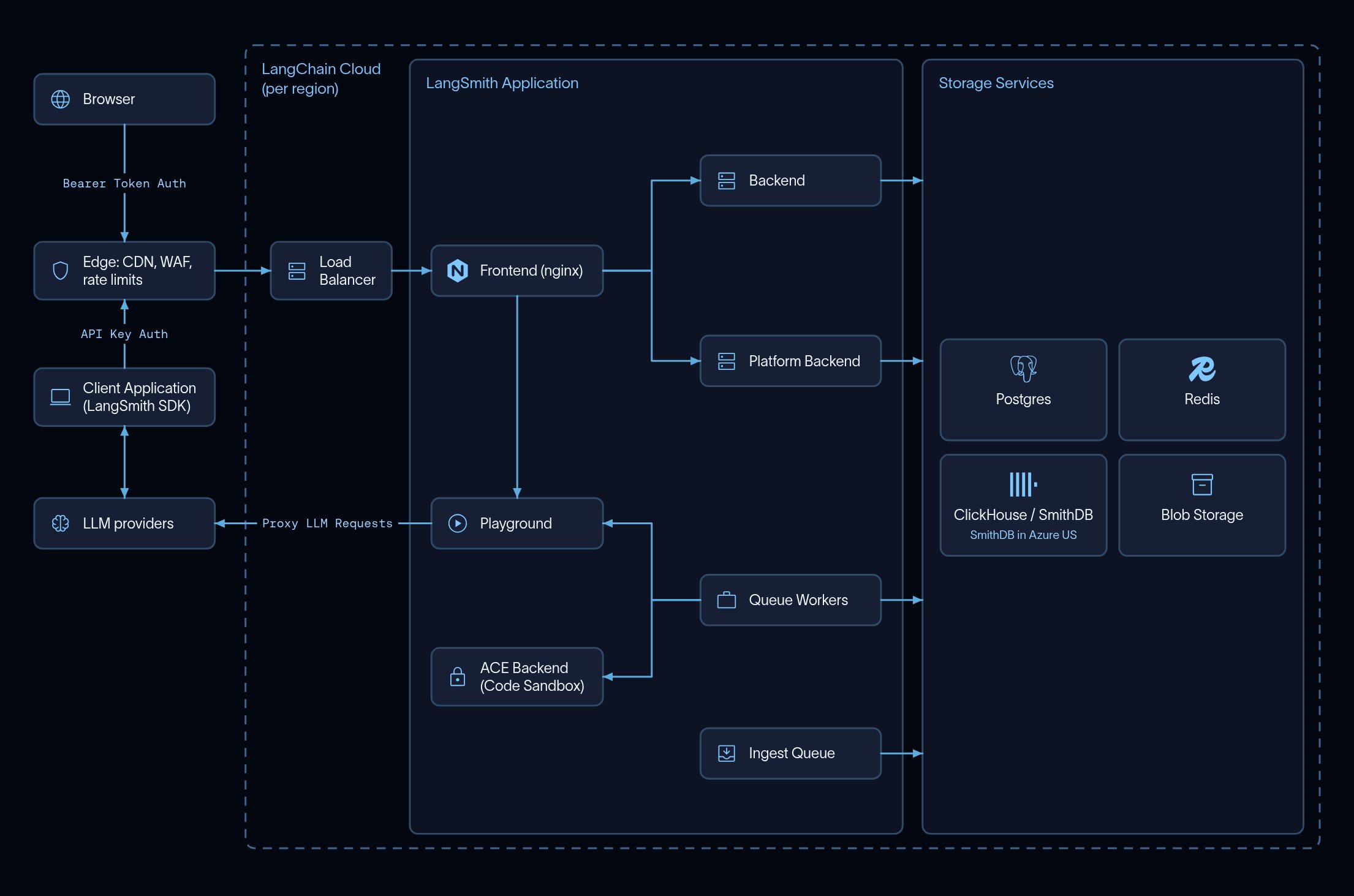
Every region runs the same LangSmith components. The following sections list the cloud services that host them in each region.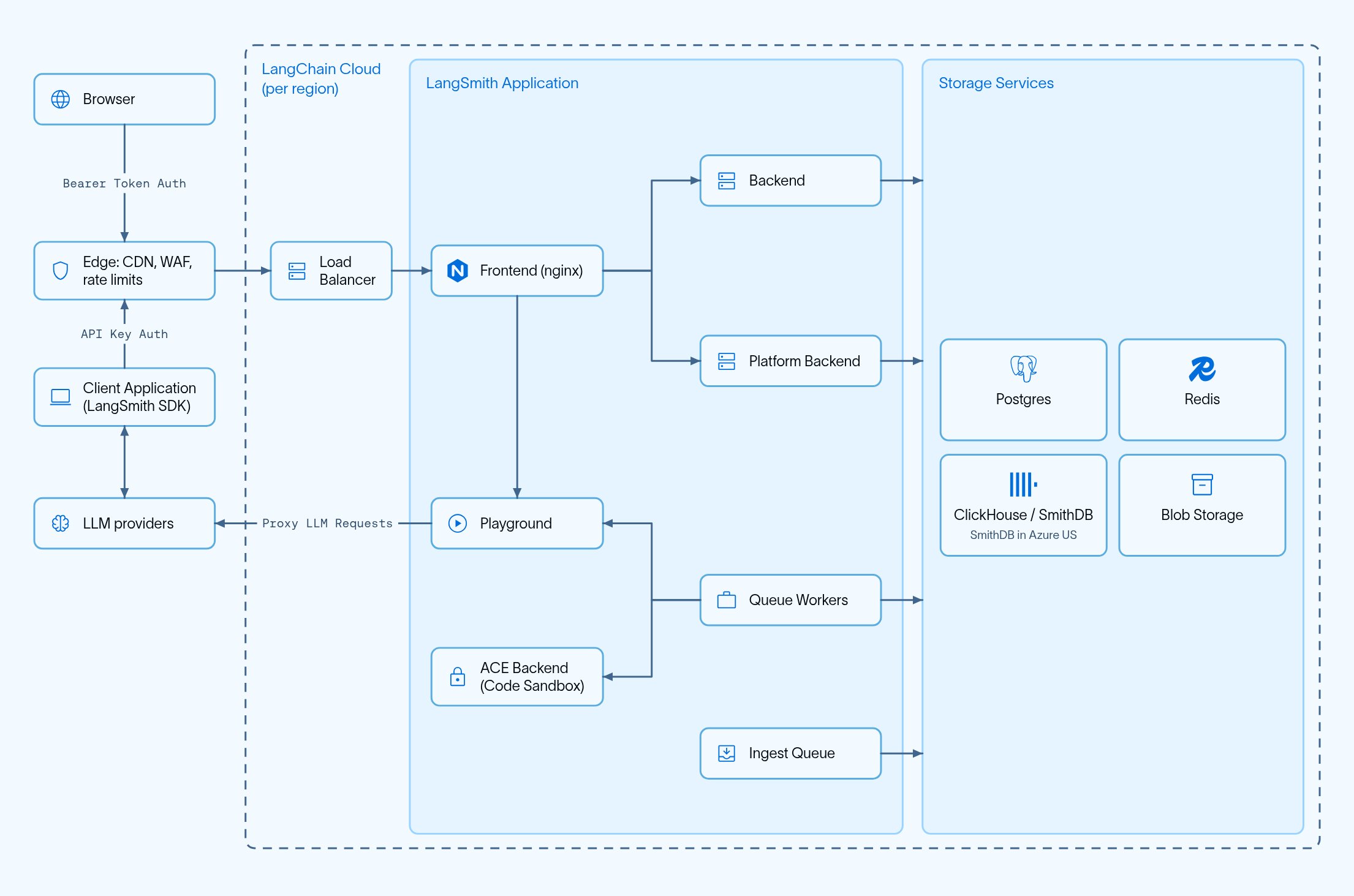
GCP services
The following applies to the US, EU, and APAC SaaS regions on GCP. LangSmith is composed of the following services, all hosted on Google Kubernetes Engine (GKE):- LangSmith Frontend: serves the LangSmith UI.
- LangSmith Backend: serves the LangSmith API.
- LangSmith Platform Backend: handles authentication and other high-volume tasks. (Internal service)
- LangSmith Playground: handles forwarding requests to various LLM providers for the Playground feature.
- LangSmith Queue: handles processing of asynchronous tasks. (Internal service)
- LangSmith ACE Backend: runs custom code evaluators in an isolated runtime. (Internal service)
- LangSmith Ingest Queue: processes incoming traces. (Internal service)
- Google Cloud Storage (GCS) for runs inputs and outputs.
- Google Cloud SQL PostgreSQL for transactional workloads.
- Google Cloud Memorystore for Redis for queuing and caching.
- Clickhouse Cloud on GCP for trace ingestion and analytics. Our services connect to Clickhouse Cloud, which is hosted in the same GCP region, via a private endpoint.
- Google Cloud Load Balancer for routing traffic to the LangSmith services.
- Google Cloud CDN for caching static assets.
- Google Cloud Armor for security and rate limits. For more information on rate limits we enforce, please refer to Rate limits.
AWS services
The following applies to the AWS US SaaS region inus-east-2 (Ohio). The same logical LangSmith components run on Amazon EKS instead of GKE.
LangSmith is composed of the following services, all hosted on Amazon EKS:
- LangSmith Frontend: serves the LangSmith UI.
- LangSmith Backend: serves the LangSmith API.
- LangSmith Platform Backend: handles authentication and other high-volume tasks. (Internal service)
- LangSmith Playground: handles forwarding requests to various LLM providers for the Playground feature.
- LangSmith Queue: handles processing of asynchronous tasks. (Internal service)
- LangSmith ACE Backend: runs custom code evaluators in an isolated runtime. (Internal service)
- LangSmith Ingest Queue: processes incoming traces. (Internal service)
- Amazon S3 for runs inputs and outputs.
- Amazon RDS for PostgreSQL for transactional workloads.
- Amazon ElastiCache for Redis for queuing and caching.
- ClickHouse Cloud over AWS PrivateLink in
us-east-2for trace ingestion and analytics, consistent with the regional storage table above.
- Elastic Load Balancing (Network Load Balancers) and Istio ingress for routing traffic to the LangSmith services. Documented API rate limits are enforced at the Istio ingress gateway. For details, see Rate limits.
- Amazon CloudFront for caching static assets (including the web UI hostname
aws.smith.langchain.com). - AWS WAF on CloudFront for managed rule groups at the edge (for example, AWS Managed Rules common protections and Bot Control).
Azure services
The following applies to the Azure US SaaS region incentralus (Iowa). The same logical LangSmith components run on Azure Kubernetes Service (AKS) instead of GKE. Authentication data is the exception: Supabase hosts it separately, in AWS us-east-1 (N. Virginia).
LangSmith is composed of the following services, all hosted on AKS:
- LangSmith Frontend: serves the LangSmith UI.
- LangSmith Backend: serves the LangSmith API.
- LangSmith Platform Backend: handles authentication and other high-volume tasks. (Internal service)
- LangSmith Playground: handles forwarding requests to various LLM providers for the Playground feature.
- LangSmith Queue: handles processing of asynchronous tasks. (Internal service)
- LangSmith ACE Backend: runs custom code evaluators in an isolated runtime. (Internal service)
- LangSmith Ingest Queue: processes incoming traces. (Internal service)
- Azure Blob Storage for runs inputs and outputs.
- Azure Database for PostgreSQL flexible server for transactional workloads.
- Azure Managed Redis for queuing and caching.
- SmithDB for trace ingestion and analytics, storing its data in Azure Blob Storage in
centralus. This region does not use ClickHouse Cloud.
Allowlisting IP addresses
Egress from LangChain SaaS
Internet-bound traffic leaving LangSmith services is routed through a NAT gateway and originates from the following IP addresses. Vertex AI requests can use a different path, as described in Allow Vertex AI access.Agents on LangSmith Agent Server egress from a separate IP list.
It may be helpful to allowlist these IP addresses if connecting to your own AzureOpenAI service or other endpoints that may be required by the Playground or Online Evaluation.
Allow Vertex AI access
For Vertex AI connections from LangSmith SaaS on GCP, public egress IP allowlisting alone might not satisfy VPC Service Controls. Private Google Access keeps Google API traffic within Google’s network instead of using the NAT gateway’s public IP addresses. See Google’s source IP access guidance. Configure a VPC Service Controls ingress rule for the source project corresponding to your LangSmith SaaS region:
These source projects are specifically for Vertex AI connections from the US, EU, and APAC GCP SaaS regions. Use the numeric
projects/PROJECT_NUMBER value in the ingress rule, not the project ID. Restrict the rule to the calling identity, your destination projects, and the required Vertex AI operations. The connection still requires the appropriate IAM permissions. See Google’s ingress rule configuration.
Select the source project by your LangSmith SaaS region, not the Vertex AI model’s region. Pod or node scaling does not change the source project number. Moving the source workload or VPC network to another project can change the required allowlist.
Egress IP inventory
Fetch the egress IP inventory (JSON) to automate allowlist updates. Filteraddresses by:
service:langsmithorlangsmith-deployment(deployed agents).cloud:gcp,aws, orazure.region:us,eu, orapac.
cidr. Listed addresses may be used now or in the future. Poll periodically and compare version to detect changes. Review additions and removals before updating firewall rules.
Ingress into LangChain SaaS
The LangChain endpoints map to the following static IP addresses. Traffic terminates on the GCP load balancers (US/EU/APAC), the Azure ingress incentralus, or, for AWS US, the Network Load Balancer in us-east-2 (API and gateway hostnames):
Allowlist every address in the column for your region so your private network can reach LangSmith Cloud (
api.smith.langchain.com, smith.langchain.com, beacon.langchain.com, eu.api.smith.langchain.com, eu.smith.langchain.com, eu.beacon.langchain.com, apac.api.smith.langchain.com, apac.smith.langchain.com, apac.beacon.langchain.com, azure.smith.langchain.com, azure.api.smith.langchain.com, beacon.azure.langchain.com, aws.api.smith.langchain.com, aws.smith.langchain.com).
GCP US, EU, and APAC are moving to the additional addresses in the last row (34.56.47.75, 34.32.254.168, and 34.151.160.163). Add those addresses now. The current GCP addresses keep serving these hostnames until February 10, 2027. After that date, the hostnames use only the additional addresses. Remove a current GCP address from your allowlist only after the hostname no longer resolves to it. The AWS US and Azure addresses are not changing.
This list is only for LangSmith Cloud. A BYOC or self-hosted deployment uses the load balancer in your own environment. If your private network reaches Cloud over the public internet, including through a BYOC control plane connection, allowlist the Cloud addresses for your region. AWS PrivateLink, GCP Private Service Connect, and Azure Private Link do not use these addresses.
Private connectivity (Enterprise)
Enterprise only. Private connectivity is available exclusively for Enterprise customers. Contact your account representative or sales@langchain.dev to enable this feature.
AWS PrivateLink
Customers on AWS can connect to LangSmith via AWS PrivateLink, providing private connectivity from any VPC. Cross-region connectivity is supported natively.Endpoint service name
Setup
1. Request access: Contact your account representative or sales@langchain.dev with your AWS account ID. LangChain will add your account to the endpoint service’s allowed principals list. 2. Create an Interface VPC Endpoint in your AWS account. Attach a security group that allows TCP 443 inbound from your VPC CIDR (or from the instances that need to reach LangSmith):pendingAcceptance to available. Allow a few minutes after acceptance for the change to fully propagate before testing connectivity.
Configure DNS
Configure DNS so thataws.api.smith.langchain.com resolves to your VPC endpoint’s private DNS name within your VPC. You can use any private DNS solution: Route 53 Private Hosted Zones, a corporate DNS resolver, or any DNS server reachable from your VPC.
First, get your endpoint’s DNS name:
aws.api.smith.langchain.com pointing to that DNS name. Here’s an example using Route 53:
Verify connectivity
From an EC2 instance or container in your VPC:GCP Private Service Connect
Enterprise customers on GCP can connect to LangSmith via Private Service Connect (PSC), providing private connectivity without exposing traffic to the public internet.Service attachment URIs
Use the following service attachment URIs to create a PSC endpoint in your VPC:PSC domains
After setup, use the following domains to connect to LangSmith over your PSC connection:Setup
Request access: Contact your account representative or sales@langchain.dev with your GCP project ID. LangChain will add your project to the service attachment’s allowed consumer list. After access is granted, create a PSC endpoint and configure DNS using either the gcloud CLI or Terraform.Create a PSC endpoint
Create a forwarding rule in your VPC targeting the service attachment:Configure DNS
Create a private DNS zone in your VPC and add an A record pointing to the PSC endpoint IP:Verify connectivity
From a VM in your VPC:Azure Private Link
Customers on Azure can connect to the LangSmith Azure SaaS API through Azure Private Link. A private endpoint in your virtual network (VNet) connects to the LangSmith Private Link service.Request access
Contact your account representative or sales@langchain.dev with your Azure subscription ID and desired endpoint region. LangChain adds your subscription to the Private Link service auto-approval list. LangChain also provides the service resource ID. Wait for LangChain to confirm that subscription access is enabled before creating your private endpoint. New connections from an allowlisted subscription are approved automatically. Connections from other subscriptions require manual approval.Create a private endpoint
Use an existing subnet in your VNet. Set the endpoint location to the subnet’s region. Replace the placeholders with your Azure resource details and the service resource ID provided by LangChain. The following Terraform example uses the AzureRM provider:Terraform
Approved before testing connectivity. If the connection remains Pending, send the private endpoint ID to LangChain to confirm subscription access and resolve the pending request.
Configure DNS
Configure private DNS so thatazure.api.smith.langchain.com resolves to your private endpoint’s IP address inside your VNet. Add the following resources to the same Terraform configuration:
Terraform
azure.api.smith.langchain.com to the private endpoint IP. Linking an Azure private DNS zone alone does not configure your custom resolver.
This example configures private access to the API hostname only. For private access to the LangSmith UI or other services, contact LangChain for additional hostnames.
Verify connectivity
From a VM or container in your VNet, confirm that DNS returns the private endpoint IP and HTTPS succeeds:https://azure.api.smith.langchain.com as your LangSmith API endpoint. API keys and workspace permissions still apply.
API rate limits
LangSmith enforces rate limits on API endpoints to ensure service stability and fair usage. The following table shows the rate limits for different endpoints in the GCP US and GCP EU regions. GCP APAC and AWS US enforce comparable service-specific limits; contact support if you need exact limits for your organization. Note that:- Rate limits are expressed as
count / intervalwhere count is the number of requests allowed within the interval (in seconds). For example,2000 / 10means 2000 requests per 10 seconds. - When no HTTP method is specified in the endpoint column, the rate limit applies to all HTTP methods for that endpoint.
- When a specific method is listed (e.g.,
POST,GET), the rate limit applies only to that method.
Rate limit categories
- High throughput: General high-volume endpoints for core operations like authentication, metadata, and feedback.
- Repository: Repository and prompt management operations.
- Run ingest: Individual trace/run ingestion endpoints for observability.
- Charts: Chart generation and visualization endpoints.
- Multipart ingest: Bulk run ingestion via multipart upload for high-volume tracing.
- Run query (API): API key-based run query operations with stricter limits for complex queries.
- Run query (User): User-based run query operations with higher limits for interactive use.
- Generation: AI-powered code and content generation endpoints (limited to prevent abuse).
- Commits: Prompt versioning and commit operations.
- Deletion: Session deletion and workflow trigger operations.
- Run lookup: Retrieving specific runs by UUID.
- Examples: Fetching dataset examples for few-shot prompting.
- Default (API key): Fallback rate limit for authenticated API requests not matching specific patterns.
- Default (User): Fallback rate limit for authenticated user requests not matching specific patterns.
- Public download: High-volume public download endpoints for shared resources.
- Stats: Run statistics and analytics endpoints (region-specific limits apply).
- Public (catch-all): Default rate limit for unauthenticated public access.
Connect these docs to your agent of choice via MCP for real-time answers.