

- Tracking agent behavior with logging, analytics, and debugging.
- Transforming prompts, tool selection, and output formatting.
- Adding retries, fallbacks, and early termination logic.
- Applying rate limits, guardrails, and PII detection.
createAgent:
The agent loop
The core agent loop involves calling a model, letting it choose tools to execute, and then finishing when it calls no more tools: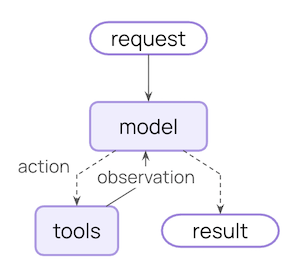
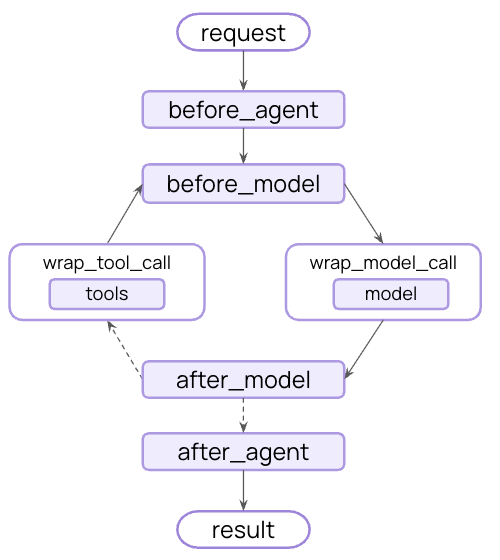
Use middleware inside a LangGraph workflow
Middleware is not a separate runtime: hooks run inside the compiled LangGraph thatcreate_agent returns. You can drop the whole agent (middleware and all) into a larger StateGraph as a node or subgraph, and every middleware hook continues to run.
Reach for this pattern when the surrounding topology is more than a standard “loop until done”: classifying input before routing to one of several agents, fanning out work in parallel, or stitching agent calls together with deterministic steps.
HumanInTheLoopMiddleware matches against each tool’s .name.
The key matches the name you pass to tool({...}, { name }).
Additional resources
Built-in middleware
Explore built-in middleware for common use cases.
Custom middleware
Build your own middleware with hooks and decorators.
Middleware API reference
Complete API reference for middleware.
Middleware integrations
Provider-specific middleware for Anthropic, AWS, OpenAI, and more.
Testing agents
Test your agents with LangSmith.
Connect these docs to your agent of choice via MCP for real-time answers.