

Async subagents are not available to end-users in Deep Agents Code at this time.
AGENTS.md file:
Continue the parent conversation
The built-ingeneral-purpose subagent inherits the parent agent’s conversation and system prompt. This context lets delegated work continue without repeating the investigation, decisions, or other details already established in the parent conversation.
To run the built-in general-purpose subagent in isolated mode instead, set the following variable in your shell or global ~/.deepagents/.env:
name and description (same as the SubAgent dictionary spec). The markdown body becomes the subagent’s system_prompt. In addition to the base spec, AGENTS.md files support an optional model frontmatter field that overrides the main agent’s model for this subagent. Use the provider:model-name format (e.g., anthropic:claude-opus-4-8, openai:gpt-5.5). Omit it to inherit the main agent’s model.
Other
SubAgent fields (tools, middleware, interrupt_on, skills) are currently not configurable via AGENTS.md frontmatter—custom subagents defined this way inherit the main agent’s tools. Use the SDK directly for full control.File format
SubagentAGENTS.md files use YAML frontmatter followed by a markdown body:
Dynamic subagents
dcode ships with the code interpreter enabled, so dynamic subagents work out of the box.
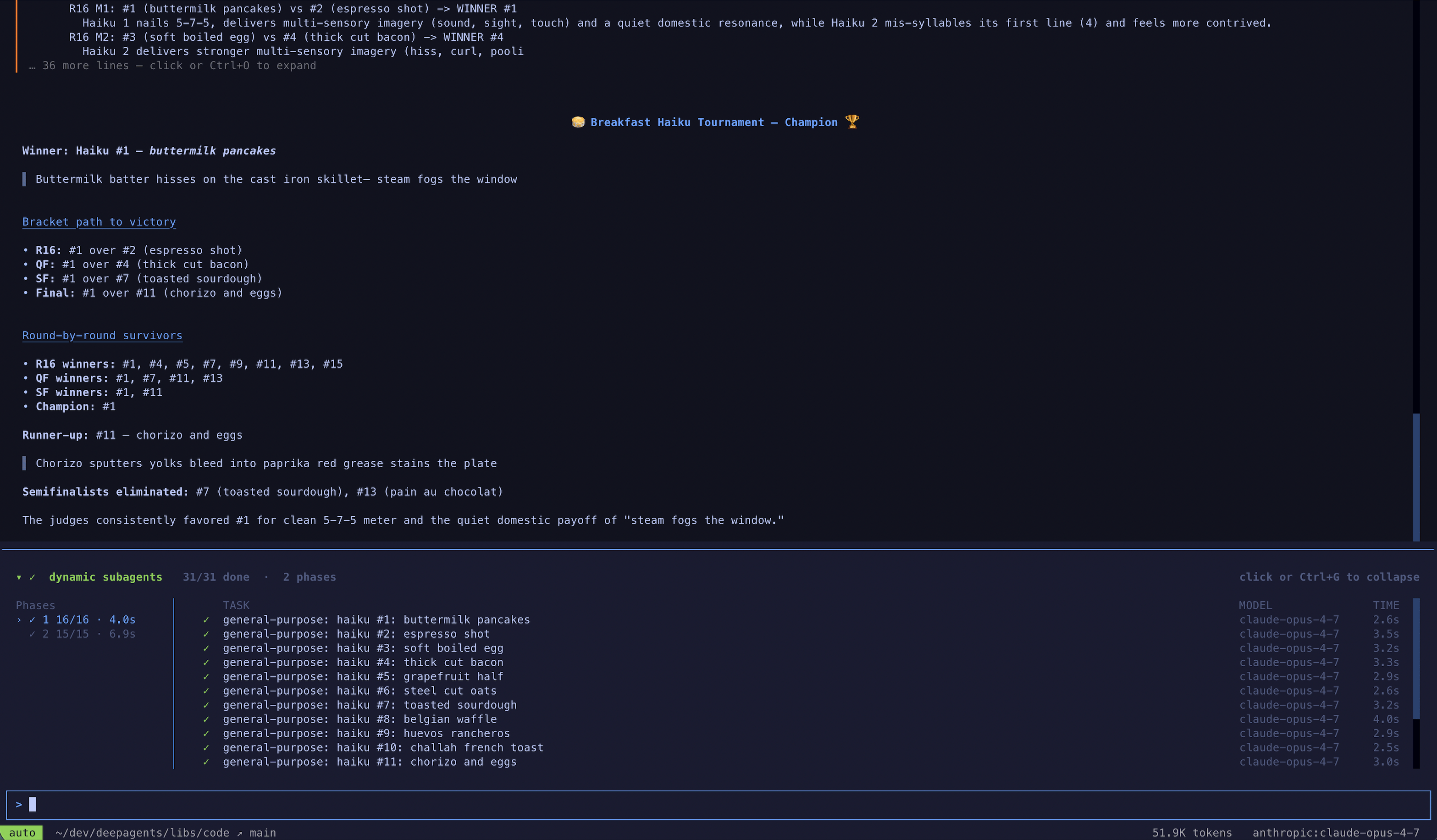
To trigger dynamic subagents, ask for a “workflow”. Instead of doing the work itself or managing fan-out through its native task tool, the agent writes an orchestration script that calls the built-in task() global and runs it in the code interpreter. For example: “Run a workflow to review every file in src/ for SQL injection.”
As subagents spawn, dcode shows them live in the dynamic subagents panel, grouped into phases by dispatch.
Example: cost-efficient subagents
Use a cheaper, faster model for simple delegation tasks while keeping the main agent on a more capable model:Connect these docs to your agent of choice via MCP for real-time answers.