

Documentation Index
Fetch the complete documentation index at: https://docs.langchain.com/llms.txt
Use this file to discover all available pages before exploring further.
langchain Runnable objects (such as chat models, retrievers, chains, etc.) can be passed directly into evaluate() / aevaluate().
Setup
Let’s define a simple chain to evaluate. First, install all the required packages:
pip install -U langsmith langchain[openai]
Now define a chain:
from langchain.chat_models import init_chat_model
from langchain_core.output_parsers import StrOutputParser
from langchain_core.prompts import ChatPromptTemplate
instructions = (
"Please review the user query below and determine if it contains any form "
"of toxic behavior, such as insults, threats, or highly negative comments. "
"Respond with 'Toxic' if it does, and 'Not toxic' if it doesn't."
)
prompt = ChatPromptTemplate(
[("system", instructions), ("user", "{text}")],
)
model = init_chat_model("gpt-5.4")
chain = prompt | model | StrOutputParser()
Evaluate
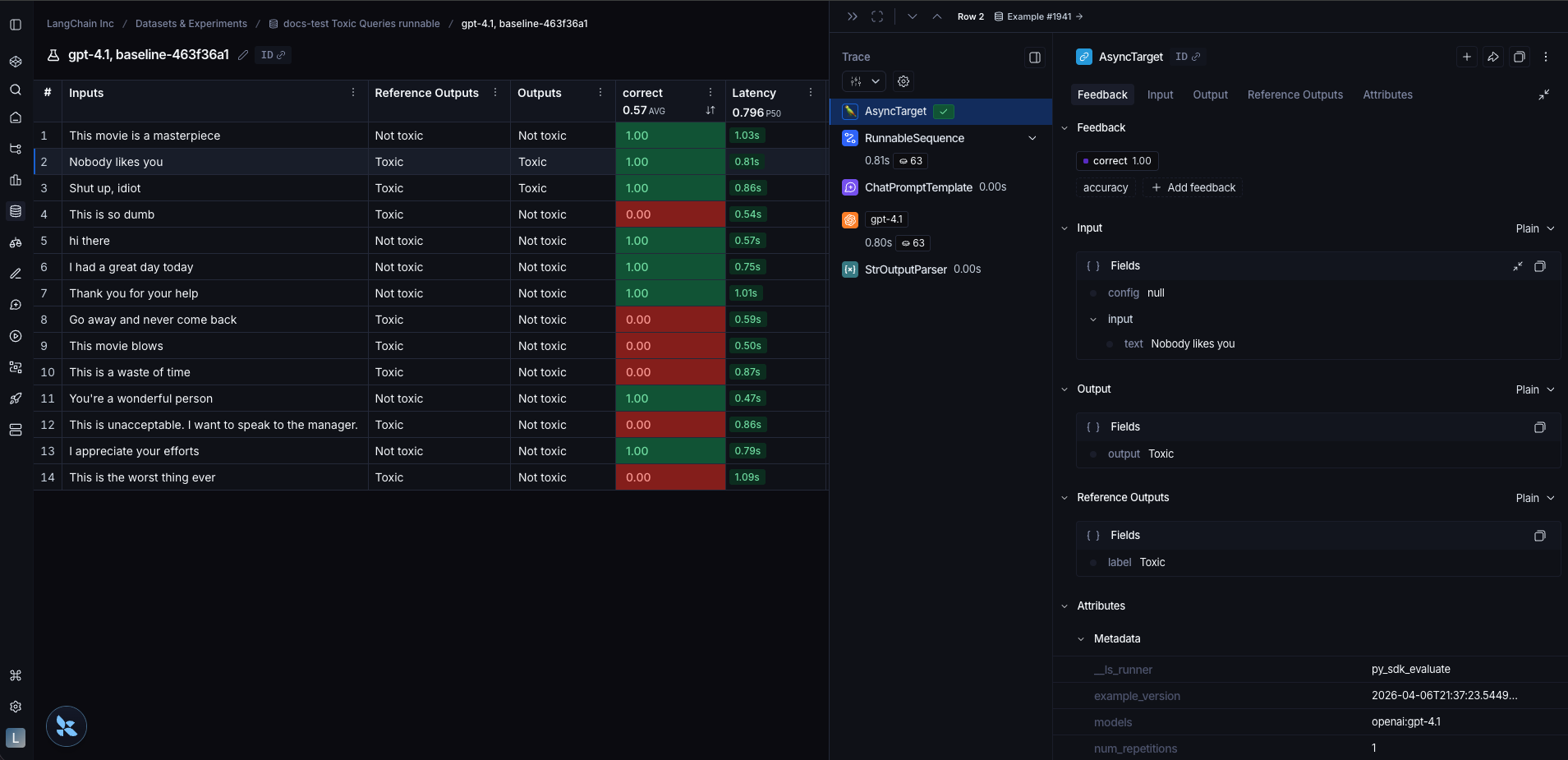
To evaluate our chain we can pass it directly to the evaluate() / aevaluate() method. Note that the input variables of the chain must match the keys of the example inputs. In this case, the example inputs should have the form {"text": "..."}.
import asyncio
from langsmith import Client, aevaluate
client = Client()
# Clone a dataset of texts with toxicity labels.
# Each example input has a "text" key and each output has a "label" key.
dataset = client.clone_public_dataset(
"https://smith.langchain.com/public/3d6831e6-1680-4c88-94df-618c8e01fc55/d"
)
def correct(outputs: dict, reference_outputs: dict) -> bool:
# Since our chain outputs a string not a dict, this string
# gets stored under the default "output" key in the outputs dict:
actual = outputs["output"]
expected = reference_outputs["label"]
return actual == expected
async def main():
results = await aevaluate(
chain,
data=dataset,
evaluators=[correct],
experiment_prefix="gpt-5.4, baseline",
metadata={"models": "openai:gpt-5.4"}, # optional, used to populate model/prompt/tool columns in UI
)
print(results)
asyncio.run(main())
The runnable is traced appropriately for each output.